
Finding Miami Beach Residents
A useful Miami Beach residents directory is assembled from records kept by different custodians. Start with the fact you can verify. An address belongs first in the Miami-Dade Property Appraiser search. A name may appear in the property roll, a recorded deed, a court index, a professional license, or an old directory. A date and former address often point toward library and archive material. Each source proves a narrow fact at a point in time. None is a complete household list.
The strongest result uses two independent anchors, such as a folio plus a recorded instrument, or a full name plus the same address in a second official index. A folio is the county parcel identifier. It travels more reliably than a typed street address when a building has units, a hotel changed names, or land was replatted. Miami Beach has many condominiums, so retaining the unit and folio prevents records for neighboring units from being mixed.
- Search the county property roll by owner, street address, or folio. Save the legal description and sales references.
- Check personal voter status through Florida's official tool, or request a defined nonexempt voter-data extract from Miami-Dade Elections.
- Carry the owner name, legal description, CFN, or book and page into the County Recorder's index.
- For an older trail, consult Miami-Dade Public Library System directories, censuses, obituary records, and microfilm.
- When no portal holds the needed item, send a narrow Chapter 119 request to the office that created it.
Miami Beach Directory Custodians
Miami Beach is an incorporated city, but Miami is the Miami-Dade county seat. City Hall keeps permits, plans, code matters, business tax receipts, and local administrative records. County offices maintain the durable ownership, recorded-document, court, tax, and election trails. State agencies hold vital records, corporations, licenses, and statewide historical material. That split matters. Sending an old-deed question to City Hall delays the search, while sending a city permit request to the County Recorder misses the correct file.
Miami-Dade Property Appraiser
County constitutional office
Miami-Dade County, FL
Use current official contact
Miami-Dade Elections
County voter-data custodian
Miami-Dade County, FL
Current contact on official site
Miami Beach Property Search
The Miami-Dade Property Appraiser offers the best first check for an address or titled owner. Its real-estate search accepts an address, owner name, folio, or subdivision. Results can include current and prior ownership, sales, building traits, assessed and taxable values, exemptions, sketches, aerial views, and condo-owner lists. The situs address is the physical parcel address. The owner mailing address is where tax mail goes. A mismatch suggests that the titleholder receives mail elsewhere, but it does not name a renter.
| Search field | Use | Format note |
|---|---|---|
| Address | Find a parcel or condo complex | House number, street, and suite where known |
| Owner name | Find titled property | Try name variants and company names |
| Folio | Open one exact parcel | Strongest link across county systems |
| Subdivision | Browse a recorded development | Confirm lot, block, and plat |
Search results are leads, not a Miami Beach household roll. Homestead exemption can support owner occupancy, yet it cannot prove uninterrupted residence or identify every person at an address. The full street and condominium workflow belongs in the Miami Beach street directory.
The official property-search screen shows the local search modes in use.
Open the Miami-Dade Property Appraiser search.
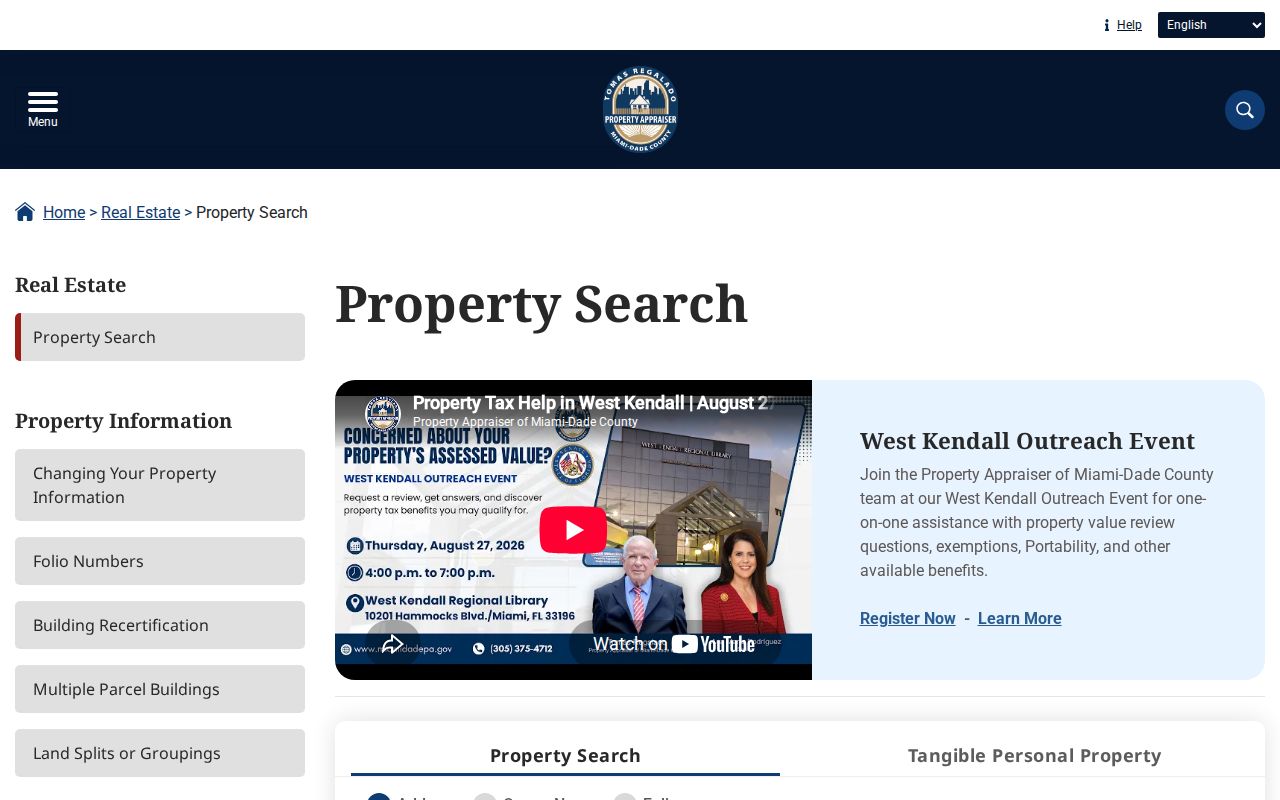
The tabs make it possible to move from a street address to the exact county folio before opening deeds or city permit records.
Recorded Miami Beach Names
The Miami-Dade Clerk of the Court and Comptroller also serves as County Recorder. Official Records include deeds, mortgages, liens, affidavits, plats, judgments, declarations of domicile, satisfactions, powers of attorney, and other filed instruments. A result can tie a person or company to a legal description and recording date. A declaration of domicile is a dated statement, not automatic proof that a person stayed at that address.
Most recorded documents from 1974 forward are searchable online. Earlier records are being added, but the downtown Records Library remains the fallback for the retained index and copies. Public computers support party name, Clerk's File Number, legal description, and official-record book/page research. Mail requests should give a full name and document type; deed or mortgage requests should also include the address or legal description. Copies cost $1 per page, certification costs $2, and a staff search costs $2 per name per year.
Records Library tip. Copy the last online deed's grantor, book and page, and legal description before working backward through the pre-1974 index.
Current Miami Beach Resident Rolls
No official Miami Beach residents directory lists each household. Current records describe separate groups: owners, registered voters, parties to recorded documents, permit participants, and people named in public cases or licenses. Their dates and purposes differ. Use the source whose scope fits the question, then confirm the same identity in another official record.
| Source | Who It Lists | Keeper | Access |
|---|---|---|---|
| Property roll | Titled owners | Property Appraiser | Free web search |
| Voter registration | Nonexempt registered voters | Miami-Dade Elections | Self-check or defined data request |
| Official Records | Parties to filed instruments | County Recorder | Basic index free; copies may cost |
| Civic Access | Permit, code, license, and project parties | City of Miami Beach | Public search; account for transactions |
| Court index | Public case parties | Miami-Dade Clerk | Division-specific portals and counters |
Property and voter records are often mistaken for complete directories. They are not. The roll omits renters and untitled household members. The state voter-status portal verifies a person's own registration; it is not a public street browser. Miami-Dade Elections handles defined data products and archived voter-record requests, subject to protected-address exemptions.
Miami Beach Civic Access
The city's Civic Access system adds an address-based administrative layer. It covers building permits, plans, inspections, code cases, citizen requests, licenses, projects, business tax receipts, and specialized permits. A permit may show the work site, applicant, owner, contractor, description, dates, status, and inspections. A code case may connect an owner or responsible party with a violation and hearing trail. These names describe involvement with a record, not residence.
Public search is available without an account, while submissions and transactions use registration. Since the dynamic interface can change, begin with its broad categories or a known record number, address, or keyword. If the portal fails, use the city department counter or make a Chapter 119 request that names the address, record type, department, and date span. Ask for electronic delivery and an estimate before extensive-use charges are incurred.
See Miami Beach's Civic Access instructions.
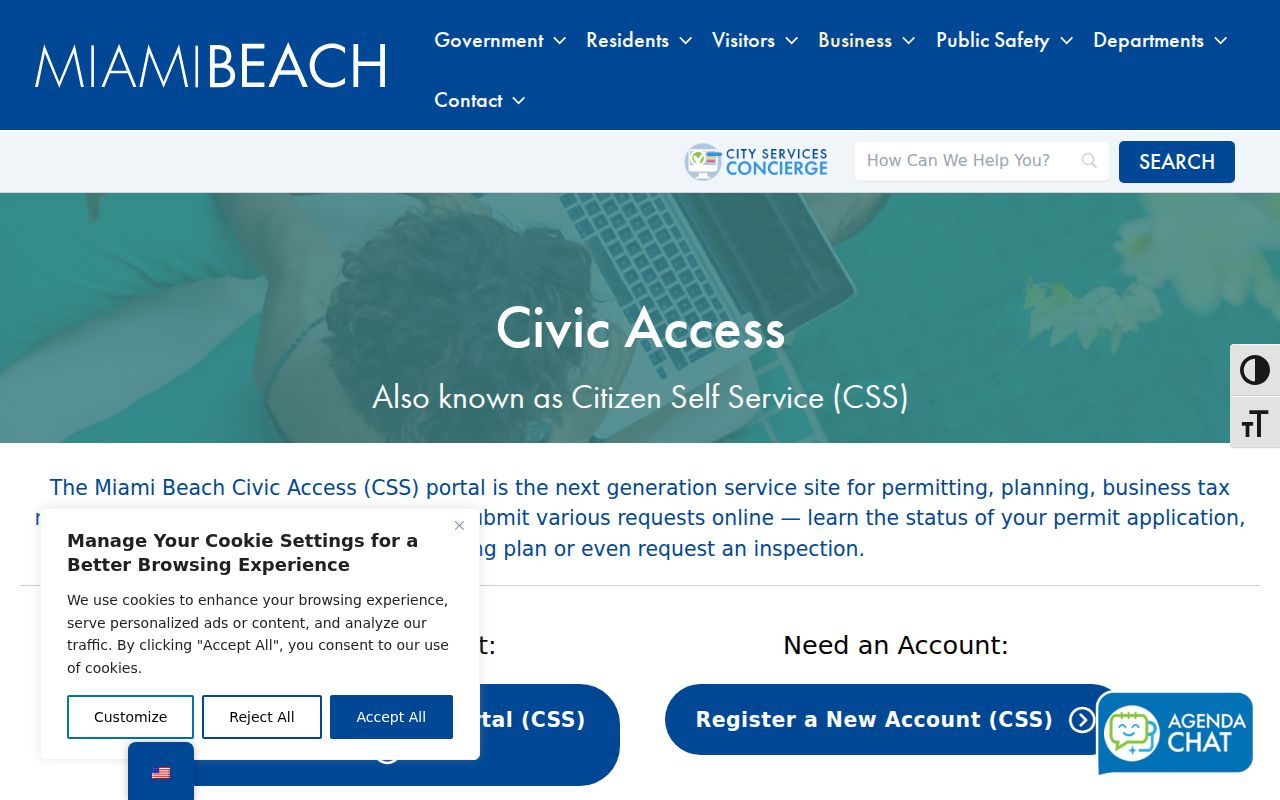
The city gateway separates public searching from account-based applications, helping a researcher choose the right channel.
Florida Voter Record Boundaries
Florida voter registration information is generally public, including name, address, date of birth, party, phone, and email, subject to statutory exemptions. The state status lookup asks for identifying data and serves personal registration checks. It should not be presented as a browse-by-street directory. For a lawful Miami Beach research need involving nonexempt roll data, request a defined geographic extract from Miami-Dade Elections and state the snapshot date, fields, geography, and file format.
Some residents have protected records. The Florida Attorney General Address Confidentiality Program provides a substitute address for qualifying victims of domestic violence or stalking. Other occupation- and victim-based exemptions can protect home addresses and related details. An absent result may therefore reflect an exemption, a name variation, a move, or nonregistration. It is not proof that someone does not live in Miami Beach.
Miami Beach Court Name Clues
The Miami-Dade Clerk records gateway separates civil, family, probate, criminal, marriage, tax deed, traffic, and code-enforcement systems. Public dockets can provide a party name, case number, role, filing date, case type, status, judge, event dates, and releasable images. A docket entry is an index pointer. It is not a certified court record, and a charge is not a conviction.
Probate has special value for family history and estate research because public petitions and notices may identify a decedent, petitioner, personal representative, counsel, or interested person. Protected inventories, sealed matters, juvenile cases, adoption files, victim details, and other confidential material remain restricted. Older or non-imaged files may require a clerk counter visit, archived retrieval, or a copy request with the case number and document date.
View the Clerk's Miami-Dade record systems.
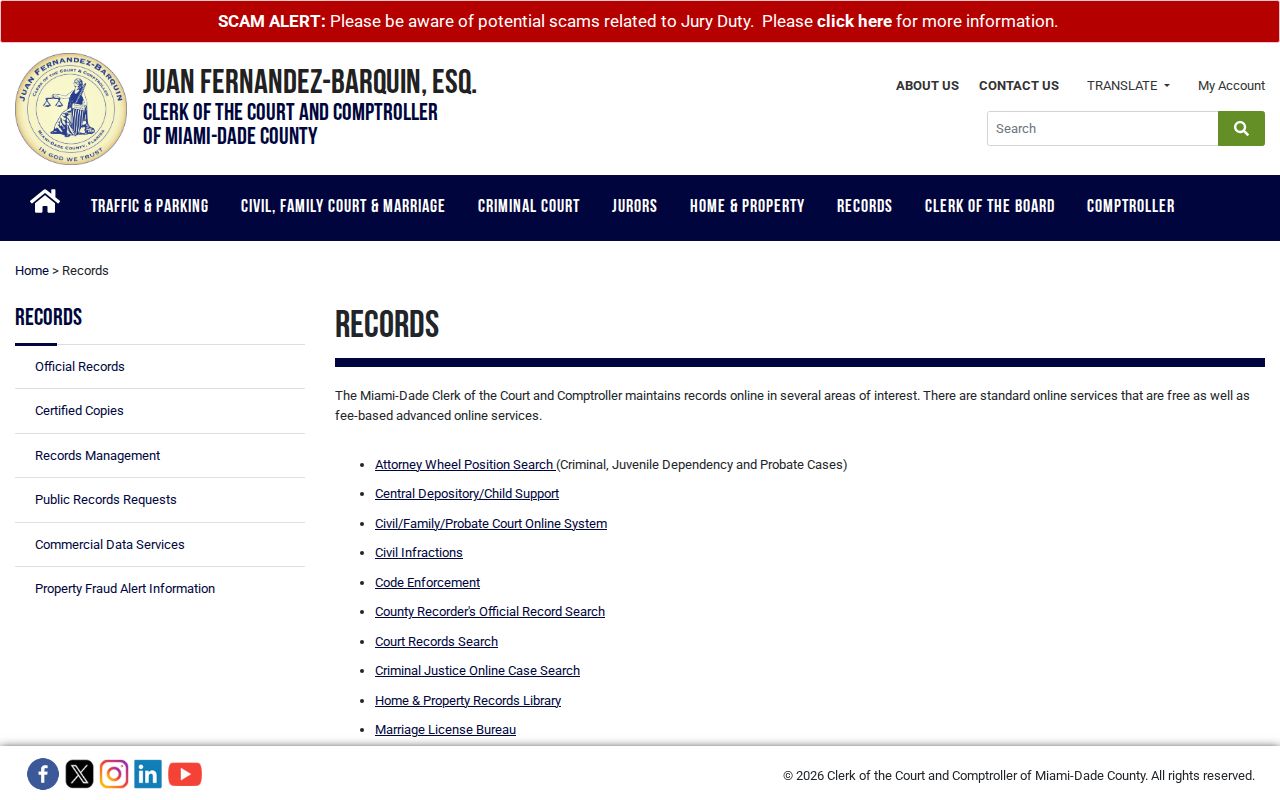
The menu shows why a name must be searched in the correct division rather than treated as one countywide resident list.
Miami Beach Vital Record Paths
Florida vital records answer narrow identity and family-history questions, but access depends on the event and age of the record. The Department of Health holds births and deaths, while the Miami-Dade Clerk records county marriage licenses and full divorce judgments. Statewide marriage certificates and dissolution abstracts are public. Birth records less than 125 years old are confidential. A death certificate without cause is public to an adult requester, while cause of death remains confidential for 50 years.
Use the official Florida applications for birth, death, marriage, and dissolution requests. State Bureau service is available by mail and in Jacksonville, with eligible local service through DOH-Miami-Dade for Florida births from 1917 forward and recent Florida deaths. Historical indexes, cemeteries, churches, and library databases offer discovery paths when an event predates statewide registration. A certificate or judgment remains the proof.
Miami Beach incorporated in 1915, two years before systematic statewide vital registration began. That gap explains why an early resident may be easier to place through a deed, directory, church record, notice, or census.
Miami Beach License Directories
State and local license databases can confirm a dated professional or business affiliation. Florida DBPR covers regulated businesses and occupations. The Department of Health practitioner system covers licensed health professionals. Sunbiz indexes corporations, limited liability companies, officers, managers, registered agents, filing addresses, and document images. Miami Beach Civic Access adds local licenses and business tax receipts.
These are affiliation records, not proof of a home. A registered agent may use an office. A professional can work in Miami Beach while living elsewhere. A company principal address may belong to a building rather than a person. Preserve the license or document number, status, filing date, profession, and exact role, then compare those facts with an independent owner, deed, court, or directory entry.
View Florida's business and professional license search.
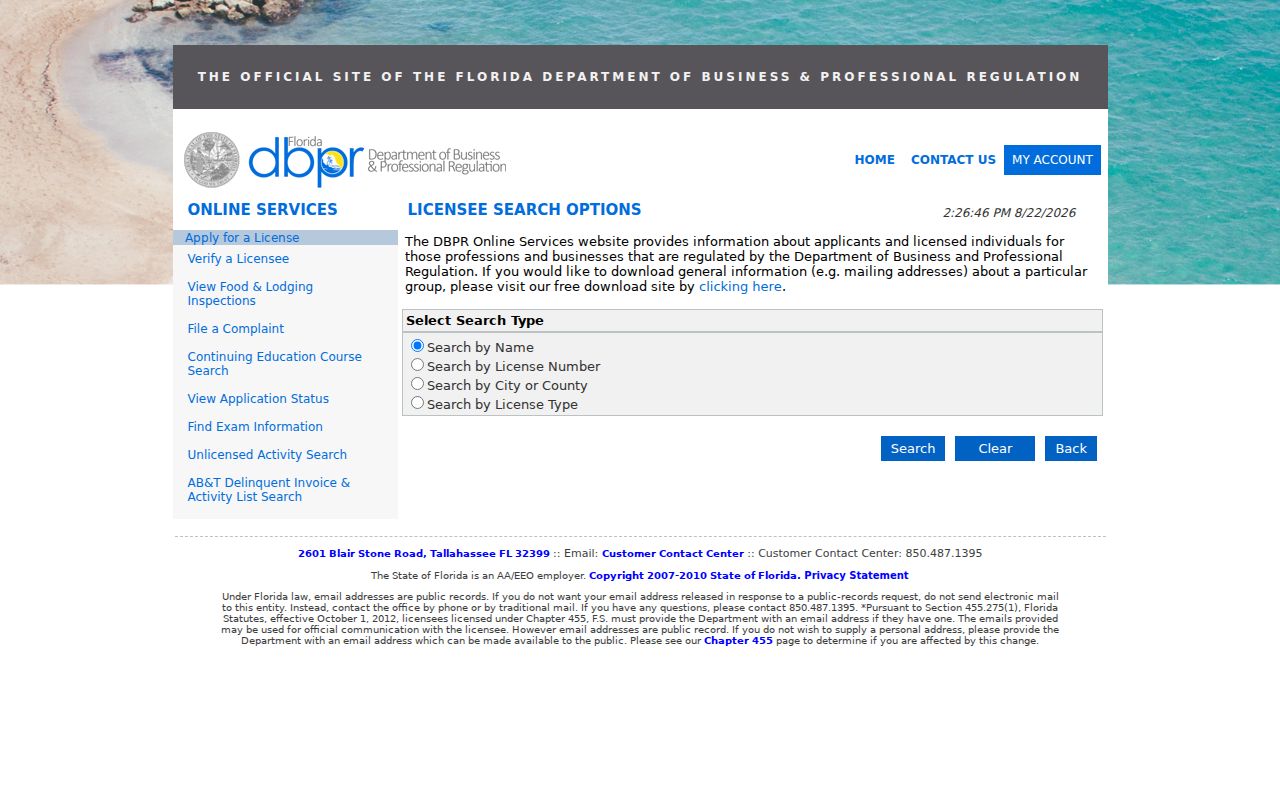
The state search supplies a dated license trail that can separate two same-name people without treating an office as a residence.
Miami Beach Public Record Requests
Florida Public Records Law, Chapter 119, and Article I, section 24 of the Florida Constitution support access to nonexempt agency records. A requester generally need not be a Florida resident or explain a purpose. The agency may charge authorized duplication costs and a reasonable special service charge when a request requires extensive work. Florida law sets no fixed response-day count; production must be prompt and in good faith for the scope and exemptions involved.
A productive request asks for an identifiable existing record rather than asking staff to investigate a resident. Give the department, record type, address or folio, case or permit number when known, date range, and preferred electronic format. Ask for an itemized estimate before charges exceed a stated limit. If a portal shows nothing, confirm spelling, the former system, retention schedule, and whether another custodian holds the series. Exempt portions should be redacted while nonexempt portions are produced.
Lawful use. Search Miami Beach resident records for lawful personal research, and never use protected or public information to stalk, harass, threaten, or harm a person.
Checking Miami Beach Directory Results
Same-name errors are common in a diverse county. Search compound surnames together and apart, test hyphen and accent variants, and try reversed paternal and maternal order when appropriate. Record middle initials, spouse, occupation, company, and dated address. A folio, legal description, Clerk's File Number, court case number, license number, or Sunbiz document number is a stronger identity key than a shared name or street.
| Official source | Best evidence | Main limit |
|---|---|---|
| Property and deeds | Owner, folio, legal description, transfer | Does not name every occupant |
| Voter and permit records | Dated address or record role | Exemptions and role ambiguity |
| Library directories | Listed person at an address in one year | Gaps, lag, and omissions |
| Commercial compilations | Possible discovery lead | Can be stale or merge people |
Commercial compilations are not official and receive no endorsement. Verify each lead against the office that created the underlying record. For a deceased former resident, combine a public death record or obituary lead with probate and the deed trail. The Miami Beach residents directory is most reliable when each claim carries a source, date, identifier, and statement of what the record cannot prove.
Historical Miami Beach Directories
The MDPLS Genealogy Collection is the main local backstop when current portals stop. It holds more than 27,000 books and 35,000 microform units, selected major-city directories from the 1860s through the 1940s, telephone indexes, surname files, passenger lists, World War I draft cards, and Florida state censuses for 1885, 1935, and 1945. The unusual Alien Arrivals by Airplane at Miami, 1930-1942 microfilm can bridge migration and residence research.
Search catalogs under Miami, Miami Beach, Dade County, and Miami-Dade County. The county name changed in 1997, so a narrow modern term can hide older material. Many holdings require an onsite visit to Main Library, though genealogy staff offer reference help and some collections are digital. The State Library and Archives also holds Florida city directories from the early 1900s forward for onsite use. Exact local volume years and publishers should be confirmed in a catalog or with a librarian.
- Roll
- A custodian's list created for one public purpose.
- Index
- A finding aid that points to a record or image.
- Criss-cross directory
- A volume arranged by street and house number instead of only by surname.
- Parcel
- A legally described unit of land identified by a county folio.
Old directories can place a named householder, spouse, occupation, business, or phone at an address in one publication year, but entries can be late, incomplete, or carried forward. Pair them with deeds, censuses, obituary records, and permits. That layered method turns an old directory hit into a defensible Miami Beach residents directory trail.