
Walk a Miami Beach Street
A street directory search starts with the normalized site address, including the unit or suite. Miami-Dade's property roll establishes the folio, titled owner, legal description, sales clues, and owner mailing address. The city cadastral map confirms parcel position and nearby geography. Recorded deeds explain title transfers. Permits and code cases add dated activity at the site. Voter data and criss-cross directories may add residence evidence, but neither is a complete list of people at each door.
- Enter the full street and unit in the Miami-Dade Property Appraiser search. Save every candidate folio for a condominium building.
- Open the municipal GIS and click the target and adjacent parcels. Confirm neighborhood, historic district, ZIP, and municipal layers.
- Compare situs and owner mailing addresses, then treat homestead only as an owner-occupancy clue.
- Carry the folio, legal description, owner, CFN, or book/page into Official Records to follow title.
- Use a defined Elections data request or a dated criss-cross directory only when that source fits the lawful purpose.
Do not merge two parcels because their building names look alike. Miami Beach hotel and apartment names changed, while condo conversions split one former address into many folios. Legal descriptions, plats, and recorded transfers preserve continuity better than branding or an abbreviated unit string.
Search Miami Beach Parcels
The Property Appraiser Real Estate Search accepts address, owner name, folio, and subdivision searches. Address plus suite is essential in a condo. Partial results and the condo drilldown help reveal the separate unit folios behind one street number. A parcel result can show owner and mailing address, current and historical sales, legal description, assessed values, exemptions, building sketch, aerial views, and property traits.
| Portal field | Best street use | Caution |
|---|---|---|
| Address and suite | Find a building or exact unit | Try unit format variants |
| Owner name | Check titled parcels along the street | Not an occupant search |
| Folio | Open one parcel without ambiguity | Retain all digits |
| Subdivision | Browse a plat or development | Confirm lot and block |
A mailing address that matches the situs supports, but does not prove, owner occupancy. A different mailing address shows only where the tax notice goes. Homestead adds weight, yet can lag and does not name other people in the home. This owner-versus-occupant distinction is the central limit of every modern street directory.
Map Miami Beach Street Context
The official Miami Beach cadastral GIS publishes parcels, address labels, situs points, streets, neighborhoods, sub-neighborhoods, ZIP boundaries, municipal boundaries, and historic-site and historic-district layers. Search or zoom to an address, make the parcel layer selectable, and click the target. Record the folio rather than relying on a map label. Transfer that folio to the Property Appraiser for authoritative owner information.
The GIS is especially useful along blocks where several towers share a base parcel, an address falls near a municipal edge, or preservation context matters. It does not advertise a dedicated resident-radius search and does not itself prove ownership. Visual adjacency and parcel selection are the verified methods. Historic layers can route a property question toward preservation files and older permits.
Inspect the city cadastral layer list.
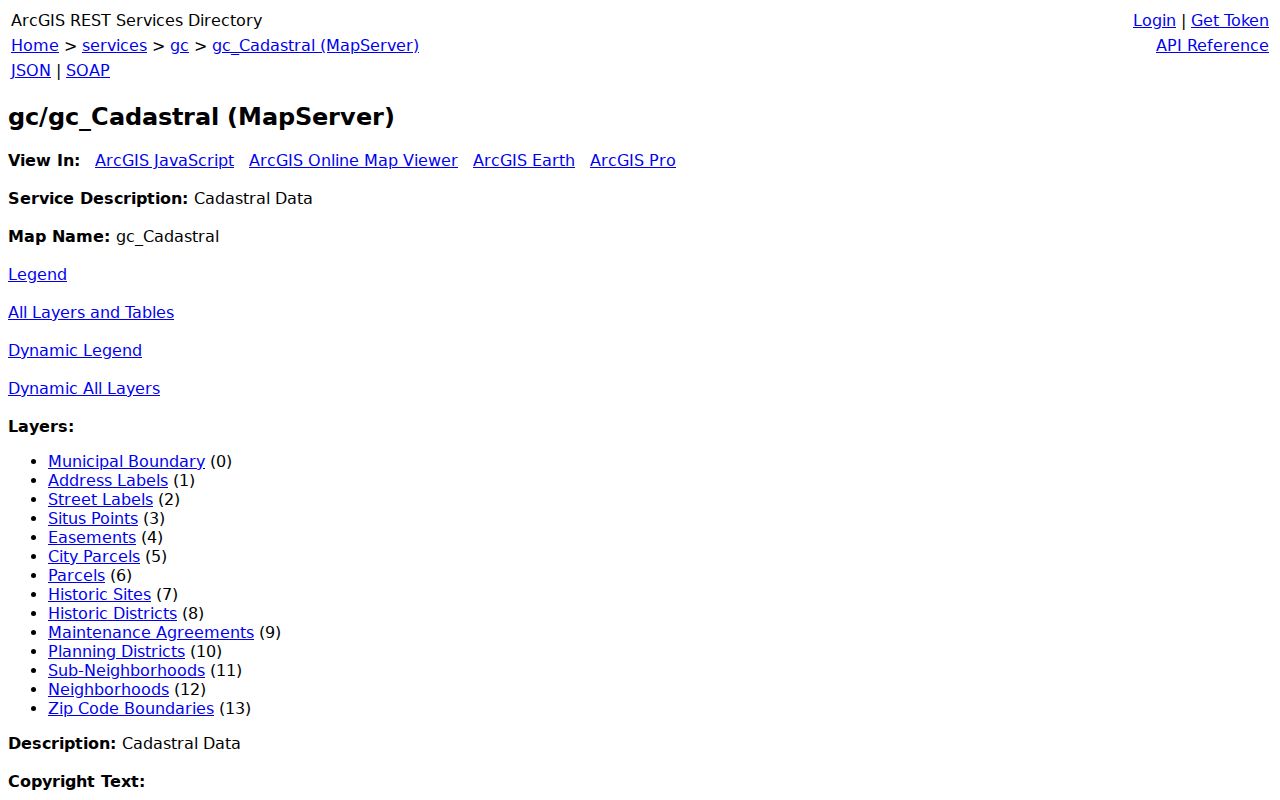
The layer inventory explains which geographic facts the map can confirm before the folio moves into the county owner search.
Miami Beach Condo Address Traps
One Miami Beach street address may represent hundreds of separate condominium folios. Begin with the building address, open the complex list, and compare the unit strings, owners, mailing addresses, and recent sales. Keep each candidate folio until another record resolves the unit. Civic Access may format the suite differently, so test the base address, full unit, abbreviated unit, permit number, and folio rather than assuming one spelling will work in every portal.
Conversions create a harder historical problem. An old hotel or apartment can predate today's unit scheme. Start from the current legal description and deed, then move through prior grantors, grantees, plats, and earlier building names. A similar hotel name is not enough to join two properties. The street directory should follow recorded land continuity.
- Parcel
- A legally described unit of land identified by a county folio.
- Situs address
- The physical location assigned to the parcel, distinct from the owner's mailing address.
- Plat
- A recorded map that divides land into lots, blocks, streets, or condominium interests.
- Criss-cross directory
- A directory arranged by street and house number for reverse address searching.
Miami Beach Street Record Layers
The address-keyed systems form a chain rather than a single roster. The property roll and GIS are the opening pair. Official Records supplies filed title documents. Civic Access adds local project and enforcement history. A voter-data request can return nonexempt fields for a defined geography. An old criss-cross volume may identify a listed householder or business in one publication year.
| Record Set | Keeper | What It Shows | Access |
|---|---|---|---|
| Property roll | Property Appraiser | Owner, mailing and situs, folio, sales, exemptions | Free web search |
| Cadastral GIS | City of Miami Beach | Parcels, streets, neighborhoods, ZIP and historic layers | Free map service |
| Deeds and liens | County Recorder | Parties, transfers, legal descriptions, filed addresses | Basic index free; copies cost |
| Voter data | Miami-Dade Elections | Nonexempt registered-voter fields in a defined extract | Written data request |
| Permits and code cases | City Civic Access | Work site, parties, work, dates, status, inspections | Public search; request fallback |
| Criss-cross volumes | MDPLS | Listed occupant or business by address and year | Catalog, digital, or onsite |
The folio and legal description link parcel records to deeds even when the street string changes. Address and permit numbers link city files. Voter data needs a snapshot date because registration changes. Historical volumes need a publication year because an entry can lag a move. Date every fact before comparing it to the next layer.
Deeds Along Miami Beach Streets
The Miami-Dade Official Records search holds deeds, mortgages, liens, satisfactions, judgments, plats, affidavits, declarations of domicile, and other filed instruments. Search by party, CFN, book/page, legal description, document type, or date where available. Basic searching is free. Advanced searches use a $1 unit. A result can show party names and roles, instrument type, recording date, CFN or book/page, and legal-description references. The image may carry addresses, witnesses, preparer, notary, and transfer detail.
Most web-indexed records run from 1974 forward. Online absence before that date is an access limit, not proof that no deed exists. The Records Library at 20 NW 1st Avenue, Suite 5.246 in Miami retains all recorded copies and indexes, offers public computers, and accepts mail requests. Call 305-275-1155 for current service details. Copies are $1 per page and certification adds $2; staff searching is $2 per name per year.
Open the County Recorder's Official Records entry.
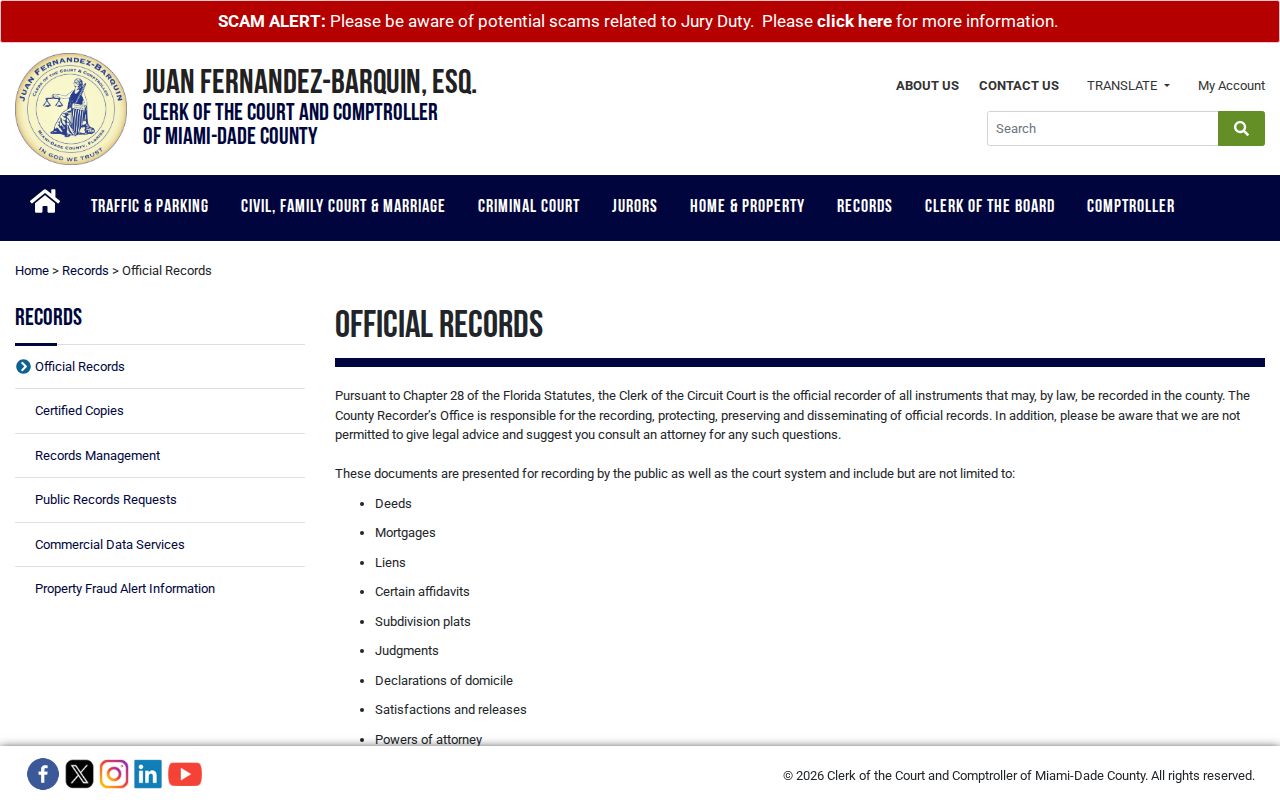
The recorder gateway leads from a parcel folio or owner name into filed instruments that explain changes along the street.
Miami Beach Permits by Address
Miami Beach Civic Access covers building permits, plans, inspections, code cases, licenses, projects, citizen requests, business tax receipts, and specialized permits. Search by an address, known record number, keyword, or record category. A result may identify an owner, applicant, contractor, work site, project description, status, dates, and inspections. Those roles show participation in a city record, not that the named person lived there.
Public search does not require an account, while applications and transactions do. Dynamic field labels can change. If the address search misses a record, try unit variants, folio, permit number, or the base building address. The city counter and a targeted Chapter 119 request are the fallbacks. Name the street address, department, record family, and date range, request electronic copies, and ask for an estimate before extensive work.
Review Miami Beach's records-request channel.
The request route fills gaps when a permit, plan, code file, or older city record is not visible in Civic Access.
Voter Data by Miami Beach Street
Florida makes many voter-registration fields public, but protected voters and statutory exemptions limit release. The state voter-status tool is for personal verification and is not a confirmed browse-by-street function. For a street-level research need, Miami-Dade Elections is the proper custodian for a defined data product. Specify Miami Beach geography, the desired nonexempt fields, snapshot date, and machine-readable format. Archived voter-related requests can be sent to register@votemiamidade.gov.
A voter record establishes registration at a reported address at a given time. It does not list children, nonregistered adults, or every occupant. Address Confidentiality Program participants and other protected categories can be absent or masked. Never treat a missing name as proof of nonresidence, and do not infer a family tie solely from a shared address.
Request Miami Beach Street Files
When an address search stops at an incomplete portal entry, ask the office for a defined existing record. Florida Public Records Law, Chapter 119, does not normally require a requester to state a purpose or live in Florida. A strong city request names the Miami Beach department, street address or folio, record family, and date range. For a building, that may mean final nonexempt permits and final inspections rather than every item ever created. Request electronic delivery when the files already exist in that form, and ask for an itemized estimate before extensive-use or copy charges are incurred.
The County Recorder needs different keys. A mail request should include the full party name and document type; a deed or mortgage request should also give the address or legal description. A known CFN or official-record book and page is better still. For Elections data, identify the Miami Beach geography, snapshot date, fields, and format instead of asking staff to find everyone on a street. If an office reports no record, confirm the spelling, unit form, former system, retention schedule, and possible alternate custodian. City permits, county deeds, and voter files are created by separate offices, so a miss in one system says nothing about the others.
Requests may be produced in stages after the custodian reviews exemptions. Protected details should be redacted while the remaining public material is released. Keep the response and any no-record statement with the street directory notes because both document exactly which source and date were checked.
Historic Miami Beach Streets
A criss-cross directory turns a Miami Beach street directory around: street first, then house number, then the listed person, business, or phone. Miami-Dade Public Library System's Genealogy Collection includes city directories and telephone indexes among more than 27,000 books and 35,000 microforms. Many items require an onsite Main Library visit, though digital collections and genealogy reference help provide other channels.
Search Miami Beach, Miami, Dade County, and Miami-Dade County in catalogs. The county's 1997 name change can hide older records under Dade. Pair directory years with Florida's 1935 and 1945 state censuses, deeds, obituary records, and permits. Exact local directory years and publishers need catalog or librarian confirmation. For a full treatment of the shelves and entry forms, use the Miami Beach city directories resource.
Limits of Miami Beach Street Records
No public source reviewed provides a Miami Beach household roster. Property results name owners, not all renters or household members. A permit can name a contractor or applicant. A business filing can name an agent whose address is an office. Homestead supports owner occupancy but cannot identify everyone in a home. Driver address data is protected by federal law, and protected voter addresses, sealed cases, juvenile and adoption matters, victim information, and confidential personal identifiers are not open.
Commercial neighbor tools compile data that can be stale or merge different people. An official index is also not self-proving: check the record date, role, address type, unit, and custodian. The sound street-by-street method documents uncertainty and verifies a key identity through a second independent record.
Lawful use. Use Miami Beach address records only for lawful personal research. Never use a street directory to stalk, harass, threaten, or harm anyone.