
Miami Beach Directory Collections
Miami-Dade Public Library System is the main local keeper for historical directory research. Its Genealogy Collection at Main Library combines city directories and telephone indexes with census schedules, passenger lists, surname files, draft records, and obituary tools. The official description does not publish a complete year-by-year Miami Beach shelf list. Exact volume years and publishers must be confirmed in the catalog or with a librarian.
| Collection | Verified years | Where held | Access route |
|---|---|---|---|
| MDPLS city directories | Selected cities, 1860s-1940s; local run unlisted | Main Library Genealogy | Mostly onsite; staff help |
| Telephone indexes | Exact years by inquiry | MDPLS Main Library | Onsite or microform |
| Florida state censuses | 1885, 1935, 1945 | MDPLS | Microform and digital sources |
| State Library directories | Early 1900s-present | Tallahassee | Catalog and onsite reference |
| Federal census | Open through 1950 | NARA/library databases | Online or library access |
Search “Miami Beach,” “Miami,” “Dade County,” and “Miami-Dade County.” The county name changed in 1997, while metropolitan editions may place island listings inside a Miami section. A broad collection statement is not proof that a specific annual edition survives.
Miami Beach Genealogy Backstop
The MDPLS Genealogy Collection reports more than 27,000 books and 35,000 microforms. A directory find can be compared at the same desk with Florida censuses, World War I draft cards, passenger lists, family histories, and the Miami-Dade Obituary Index. The collection even includes Miami alien arrivals by airplane from 1930 through 1942, a rare bridge for migration research.
Most deep holdings are for in-library use, but genealogy librarians offer onsite and electronic reference help. A useful request names the person, spelling variants, target place, and a narrow date range. The digital landing page identifies which materials can be reached remotely.
Open the official genealogy collection before planning the visit.
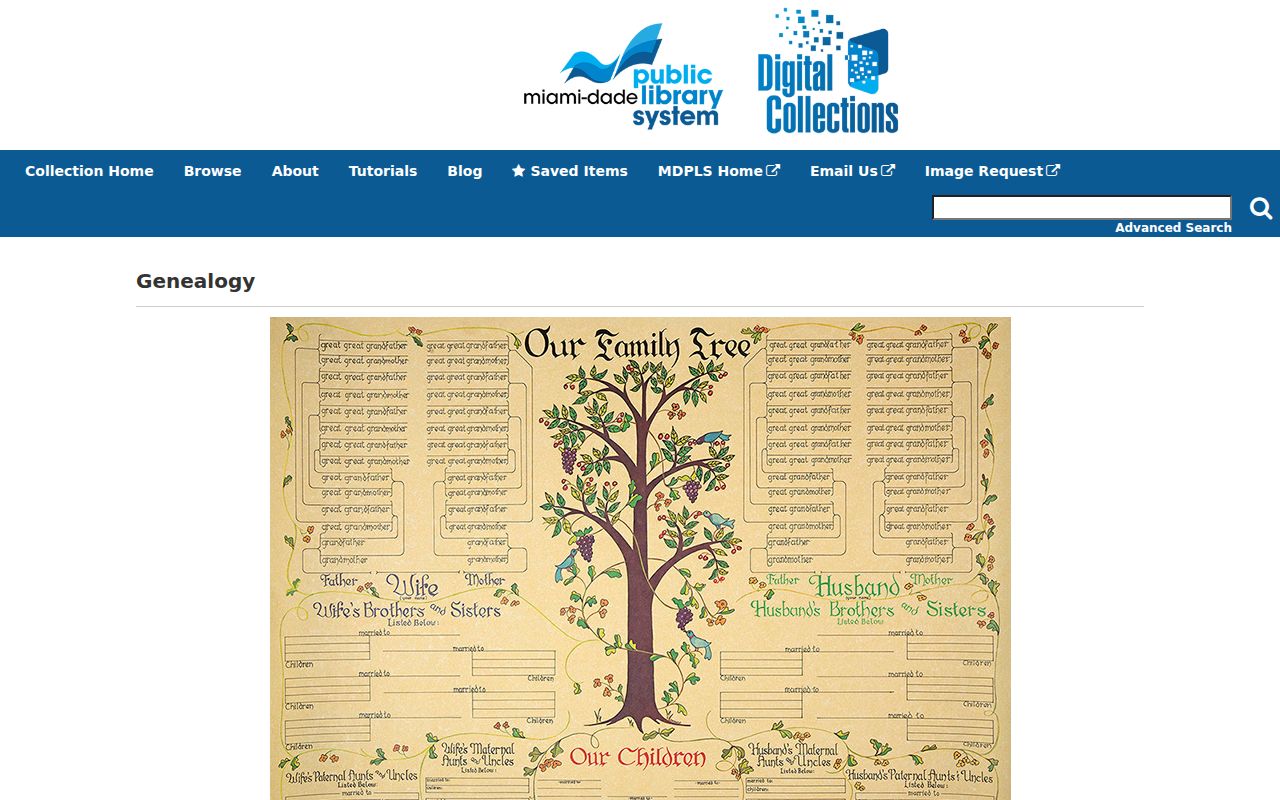
The screen separates online discovery from the printed and microform holdings that need librarian help.
Read Miami Beach Directory Entries
A conventional alphabetical entry may give surname and given name, spouse in parentheses, occupation, business affiliation or work address, and residence. Some editions mark a widow, roomer, renter, or householder. Those marks mean only what that volume’s own abbreviation key says. Copy the key before copying names.
| Name | Exact spelling, initials, spouse notation, and cross-reference |
|---|---|
| Work | Occupation, business listing, and separate business address |
| Home | Street number, street form, apartment, and residence marker |
| Status | Owner, renter, widow, or roomer only if the key defines it |
| Telephone | Number when the edition includes one |
- Criss-cross directory
- A section arranged by street and house number instead of surname.
- Householder index
- An address-led list naming the household head or main listed occupant.
- Abbreviation key
- The legend that defines symbols, occupations, and short forms.
No official Miami Beach sample page was accessible for a verified transcription. These are reading fields, not a claim about one local edition.
Catalog Miami Beach Under Three Names
Dade County was created in 1836, Miami Beach incorporated in 1915, and the county adopted “Miami-Dade” in 1997. Early island references can sit under Dade County, a Miami metropolitan title, or an old subdivision. Modern keyword habits miss them.
The State Library of Florida city directory shelf spans the early 1900s to the present and is arranged by city and year. Search every place-name form, then ask whether a Miami edition carries a separate Miami Beach section. Never state an exact publisher run until a catalog record or title page confirms it.
Review the official State Library collection for the statewide fallback.
The statewide shelf may hold a volume that a local digital search does not expose.
Note: A missing online title does not prove that a printed Miami Beach directory never existed.
Miami Beach Historical Time Bridges
Directory evidence strengthens when paired with dated records. Miami Beach’s 1915 incorporation predates systematic statewide vital registration in 1917. Florida’s 1935 and 1945 state censuses provide unusually useful mid-decade checks between federal schedules.
Before statewide registration became systematic, church, cemetery, newspaper, and county evidence may supply the missing event link. Early island land records also predate the city, so a recorded subdivision and the Dade County index may work better than a modern Miami Beach street string. Directory research should follow the place name and spelling used at the time.
| Year | Why it matters |
|---|---|
| 1915 | City incorporation; older land evidence remains under Dade County. |
| 1917 | Systematic statewide vital registration begins. |
| 1935 | Florida census checks a household between federal years. |
| 1945 | Second mid-decade household checkpoint. |
| 1950 | Latest open federal population schedule. |
| 1997 | County name changes to Miami-Dade. |
Publication and residence dates can differ. Seasonal presence, late compilation, a move, or omission can explain a mismatch. Treat a Miami Beach city directory as dated evidence, then verify it through a census, deed, obituary, or vital index.
Miami Beach’s seasonal residents and hotel population make year-to-year interpretation especially sensitive. A listed business address may name a business affiliation, while a residence mark points elsewhere. Keep both fields. A move between South Beach, Mid Beach, and North Beach may appear as a changed address without any change in the person’s occupation or spouse notation.
Reverse Miami Beach Directory Searches
A street section turns the city directory around. Find the street, locate the number, and inspect nearby addresses. This helps when surname spelling is unclear and when the goal is to reconstruct a block.
Miami Beach hotel construction, land filling, condo conversion, and renamed buildings complicate old addresses. One former hotel may now map to many folios. Use historic street entries as leads, then join them through legal descriptions, subdivision names, preservation sources, and current parcel identifiers. The Miami Beach street directory handles current address-keyed records.
Never merge two places because they shared a hotel name. Match the street number, footprint, subdivision, and dates.
Pair Miami Beach Directories With Census
Florida’s 1935 and 1945 state censuses are unusually valuable because they place a household between federal census years. Start with the nearest directory address, then compare the state schedule for names, ages, birthplace, and household structure. Return to the next available directory to see whether the family moved, a spouse notation changed, or an occupation shifted. The federal 1950 census is the latest population schedule open under the 72-year rule; the 1960 schedule is due in 2032.
A directory lists selected people, while a census attempts a household count. Neither is perfect. Seasonal Miami Beach residence, delayed publication, transcription errors, and people who chose not to be listed can create gaps. Agreement on name, spouse, occupation, and address is much stronger than one matching surname.
When a person disappears, the free Miami-Dade Obituary Index can identify a newspaper and publication date. Probate may name a personal representative or heirs, and a deed can show how title changed. Passenger lists, World War I draft cards, and the Miami airplane-arrival microfilm can explain arrival or departure. Each source should be cited by collection, year, page or image, and keeper so the finding can be checked again.
Trace Miami Beach Families Yearly
A careful family-history search records change instead of forcing each mention into one identity. Spouse, occupation, business affiliation, address, and middle initial help separate same-name residents.
- Begin with a known deed, census, obituary, or vital-event year.
- Inspect the nearest directory and copy the whole entry and key.
- Move year by year, recording spelling, spouse, work, and address.
- Check the street section and adjacent house numbers.
- Pair the trail with 1935 and 1945 Florida censuses and open federal schedules.
- Test a disappearance with obituary, probate, deed, and relocation evidence.
A missing name can mean death, a move, seasonal residence, changed spelling, or simple omission. An obituary supplies a lead. Probate or an official certificate gives firmer proof. Pre-1970 Florida divorce abstracts add another trap because they were indexed under the husband’s name.
Request Miami Beach Directory Help
A focused library request saves time and prevents unsupported claims. Give the resident’s full name, variant spellings, known spouse, approximate address, and a narrow year range. Ask staff to search catalog headings for Miami Beach, Miami, Dade County, and Miami-Dade County. If a metropolitan directory is found, confirm from its title page or coverage statement that it includes the island.
Request both the alphabetical entry and the street section. The front matter and abbreviation key should accompany any copied line because symbols differ by edition. Record the exact title, publisher, year, page, format, holding institution, and call number. For microfilm, keep the reel identifier and frame if available. These details distinguish a verified city directory citation from a loose online transcription.
Main Library is the primary local access point for the 27,000 books and 35,000 microforms in MDPLS Genealogy. Onsite readers and reference staff support material not available online, while e-reference can help test holdings in advance. The State Library’s catalog and Tallahassee shelves provide a separate channel for Florida volumes from the early 1900s to the present.
If no directory covers the target year, ask about telephone indexes, the 1935 or 1945 Florida census, the Miami-Dade Obituary Index, newspaper databases, surname files, draft cards, passenger lists, and airplane arrivals. A documented substitute source is more reliable than inventing a missing volume year.
Extend Miami Beach Directory Research
MDPLS Special Collections adds photographs, maps, films, rare books, and archives. HistoryMiami, Jewish Museum of Florida-FIU, Wolfsonian-FIU, Miami Design Preservation League, University of Miami, and FIU collections may document buildings, businesses, groups, and personal papers. Each sets its own access rules.
See the official Special Collections gateway before requesting local photographs or maps.
These companion records explain affiliations and addresses that a brief directory line cannot.
Religious registers and private organization files are not presumed public. Published board lists show dated civic ties, not a full resident roll. The Miami Beach historical election archive adds civic context from the city’s early era.